
Franchise Business Model: Meaning, Working, Benefits & Risks
A beginner-friendly guide to the franchise business model — what it means, how it operates, and whether it’s right for your business goals. Compare benefits, risks, and examples from real brands.
BUSINESS COMPLIANCE
Bizz Accelera
10/8/20257 min read


Many aspiring entrepreneurs dream of owning a business — but few have the experience to build one from scratch. The franchise model bridges that gap, offering a proven system under an established brand. In India, this model is witnessing explosive growth, from bustling city centers to emerging tier-2 and tier-3 towns. The appeal is clear: it's a ready-made business formula with reduced risk. But is it the right path for you? Let's dive deep into the world of franchising.
1. Introduction
The entrepreneurial spirit in India is stronger than ever. However, the high failure rate of new, independent businesses often deters even the most passionate individuals. Enter the franchise business model—a strategic partnership that allows you to operate a business using the brand, systems, and support of a larger, established company (the franchisor). It’s a pathway to business ownership that combines the independence of being your own boss with the security of a proven operational blueprint.
2. What is a Franchise Business Model?
In simple terms, a franchise is a business relationship where the owner of a trademark, brand, and business system (the franchisor) grants a license to an individual or group (the franchisee) to operate a business under that name, following a specific set of rules and processes.
Franchisor: The original owner and builder of the brand (e.g., McDonald's, Amul, DTDC). They provide the blueprint, training, and ongoing support.
Franchisee: You—the local business owner who invests in and runs the outlet. You are responsible for day-to-day operations, staff, and local customer service.
Franchising vs. Licensing: While similar, licensing is typically a simpler agreement for using a brand name or logo on products (e.g., a Marvel character on a t-shirt). Franchising is far more comprehensive, encompassing the entire business operation, from the look of the store to the recipe of the food and the employee training manual.
3. How the Franchise Model Works
The franchise relationship is a structured, ongoing process. Here’s a step-by-step breakdown:
Signing a Franchise Agreement: Both parties sign a legally binding contract outlining all terms, responsibilities, and fees.
Paying Initial Franchise Fee: The franchisee pays a one-time, upfront fee to the franchisor for the rights to use the brand and system.
Setup & Training Phase: The franchisee sets up the outlet as per the franchisor's specifications (layout, design, equipment). The franchisor provides comprehensive training on operations, sales, and management.
Royalty Payments: The franchisee pays ongoing fees, typically a percentage of monthly gross sales, to the franchisor for continuous support and brand usage.
Marketing & Operational Support: The franchisor provides marketing materials, advertising campaigns, and ongoing operational guidance.
Periodic Audits & Renewal: The franchisor may conduct quality checks to ensure brand standards are met. The agreement is for a fixed term (e.g., 5-10 years), after which it can be renewed.



4. Types of Franchise Models
Franchising is not a one-size-fits-all model. The main formats include:
Product Distribution Franchise: The franchisee sells the franchisor's products, acting like a dedicated retailer. Examples: Car dealerships (Toyota), Coca-Cola bottlers.
Business Format Franchise: The most common type. The franchisee gets the entire business system—trademark, products, store design, and operational manual. Examples: McDonald’s, Subway, KFC.
Manufacturing Franchise: The franchisee is licensed to manufacture and sell products under the franchisor's brand. Example: A company making packaged foods under a well-known brand license.
Job Franchise / Kiosk Model: A low-cost, often single-person operation run from a small kiosk or cart. Examples: Small food stalls (Haldiram's kiosks), courier pickup counters.
Investment Franchise: The franchisee (often a high-net-worth individual or company) invests in and manages multiple units or develops an entire territory.
5. Key Components of a Franchise Agreement
This is the most critical document. Key clauses to scrutinize include:
Franchise Fee & Royalty: The upfront cost and the percentage of sales paid regularly.
Territorial Rights: Defines your exclusive operating area to prevent competition from another franchisee of the same brand.
Brand Usage Rules: Strict guidelines on how you can use the brand's logo, name, and marketing materials.
Training & Marketing Responsibilities: Details what support the franchisor will provide and what local marketing you are responsible for.
Duration, Renewal & Termination: The contract length, conditions for renewal, and the circumstances under which the agreement can be terminated by either party.
6. Investment Requirements
The investment varies dramatically based on the brand, sector, and location.
Sectors: Food & Beverage (F&B) franchises often require higher investment than education or service-based ones.
Breakdown: Total Investment = Franchise Fee + Setup/Renovation Cost + Equipment Cost + Working Capital.
Ongoing Costs: Royalty Fee (typically 5-10% of revenue) + Marketing Fee (1-3%).
It's crucial to remember that your investment isn't just monetary; it also includes your time and a commitment to follow the brand's system diligently.
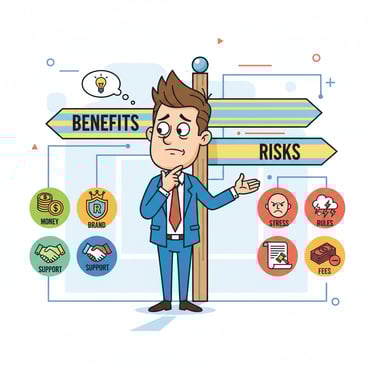
7. Benefits of the Franchise Model
Proven Business System: You get a ready-made, tested formula for success.
Brand Recognition: You start with instant customer trust and awareness.
Training & Support: Comprehensive training reduces the learning curve.
Lower Failure Rate: Statistically, franchises have a significantly higher success rate than independent startups.
Easier Financing: Banks and NBFCs are often more willing to lend to a franchisee of a known brand.
Economies of Scale: Benefit from bulk purchasing and national marketing campaigns.
8. Risks and Challenges
High Initial & Ongoing Costs: Fees and royalties can eat into profit margins.
Limited Creativity: You must operate within the franchisor's strict guidelines, leaving little room for innovation.
Reputation Dependence: Your business is tied to the national brand's reputation. A scandal at another outlet can affect you.
Location Dependency: Poor footfall or rising local competition can impact sales, regardless of the brand's strength.
Contractual Obligations: The agreement can be restrictive, and breaking it can lead to severe penalties.
9. Marketing & Brand Benefits
One of the biggest advantages is marketing muscle. As a franchisee, you benefit from national and regional advertising campaigns run by the franchisor. This includes TV commercials, digital marketing, SEO, and loyalty programs. For instance, when Domino's runs a pan-India "30-minute delivery" campaign, every Domino's franchise outlet benefits from the increased brand recall and customer orders.
10. Franchise vs. Independent Business: A Quick Comparison
When deciding between a franchise and an independent business, several key factors differ significantly.
A franchise typically has a fast startup time because it uses a proven, ready-made system, whereas starting an independent business is generally a slow process involving building everything from the ground up. Furthermore, a franchise offers instant brand recognition from day one, while an independent business starts with none initially and must build its reputation over time.
In terms of operation, a franchisee has limited control and creativity,
as they must adhere to the franchisor's strict rules. In contrast, an independent business owner has full autonomy over all decisions. This structure influences the risk level; franchising carries a low-to-moderate risk due to the established system, while going independent is considered high risk.
Finally, profit margins also differ. Franchises often see moderate profit margins because a portion of the revenue is paid to the franchisor as ongoing fees. On the other hand, an independent business has the potential for higher margins since the owner keeps all the profits, but this is not guaranteed and comes with greater financial exposure.
Who should choose what?
Choose a Franchise if you prefer a structured system, have a lower risk appetite, and want to leverage an established brand.
Choose an Independent Business if you are highly creative, have a unique idea, desire full control, and are willing to accept higher risk for potentially higher rewards.
11. Real-Life Examples (India-Focused)
McDonald’s India: A classic Business Format Franchise. Franchisees get everything from the secret sauce recipes and kitchen design to the employee training modules, ensuring a uniform customer experience globally.
Amul Parlours: A Product Distribution Franchise. Local store owners are licensed to sell the wide range of Amul dairy products. Amul manages the brand and supply chain, while the franchisee manages the retail space.
DTDC Courier: Uses a hybrid model, combining company-owned hubs with a vast network of franchisee-owned centers. This allows for rapid geographical expansion and localized service.
12. Conclusion
The franchise business model offers a compelling blend of entrepreneurship and security. It provides a proven system, brand power, and extensive support, significantly de-risking the path to business ownership. However, this comes at the cost of fees, royalties, and limited flexibility. The key to success lies in thorough due diligence—research the brand, understand the agreement, and assess your own goals and personality. Remember, franchise ownership isn’t just business buying — it’s a business partnership. Choose your partner wisely.
13. FAQs: Franchise Business Model
What is meant by a franchise business model?
It's a method where a business owner (franchisor) grants a license to an individual (franchisee) to operate under their brand name and system in exchange for fees and royalties.How much investment is needed to start a franchise in India?
Investment can range from as low as ₹5 lakh for a kiosk model to several crores for a large format restaurant or hotel. It entirely depends on the brand and sector.Do franchisees get training and marketing support?
Yes, most franchisors provide initial and sometimes ongoing training. They also run national marketing campaigns, though local marketing may be the franchisee's responsibility.Is franchising profitable in India?
Yes, it can be highly profitable if the right brand is chosen, the location is good, and the franchisee manages operations efficiently. However, profitability is not guaranteed and varies case by case.What is the difference between a franchise fee and royalty?
The franchise fee is a one-time, upfront payment for the rights to the brand. Royalty is an ongoing fee, usually a percentage of monthly sales, paid for continuous support and brand usage.Can I run multiple franchise outlets?
Yes, through an Area Development or Multi-Unit Franchise agreement, where you commit to opening a certain number of outlets in a specific territory.Which franchise business is best under ₹10 lakh?
Options include kiosks for courier services (like DTDC), small food stalls, tutoring centers (like IITian's Prashikshan), and home-based service businesses.What are the risks of buying a franchise?
Key risks include high initial investment, ongoing royalty burdens, lack of creative freedom, and dependence on the franchisor's decisions and brand reputation.How long is a franchise agreement valid?
Typically, franchise agreements in India are valid for 5 to 10 years, with an option to renew upon mutual agreement.Can a franchise be sold or transferred?
Usually, yes, but only with the prior written consent of the franchisor, who will need to approve the new franchisee.
Connect:
Get in touch with our expert team.
Follow us:
bizzaccelera@gmail.com
+91-9313528947
© 2025. All rights reserved.
Join Our News Letter
GSTIN: 24AHYPN6558P1Z4
Disclaimer : The information provided on Bizz Accelera is for general informational purposes only, We are not liable for any losses or damages in connection with the use of our website.