
How to Start an Eco-Friendly Brand in India | 5 Home Business Ideas
Start an eco-friendly brand in India with ₹15,000. Explore 5 home business ideas — coconut scrubbers, loofah soaps, soy milk & more. Full guide by Bizz Accelera.
BUSINESS IDEAS
Bizz Accelera
3/27/202614 min read
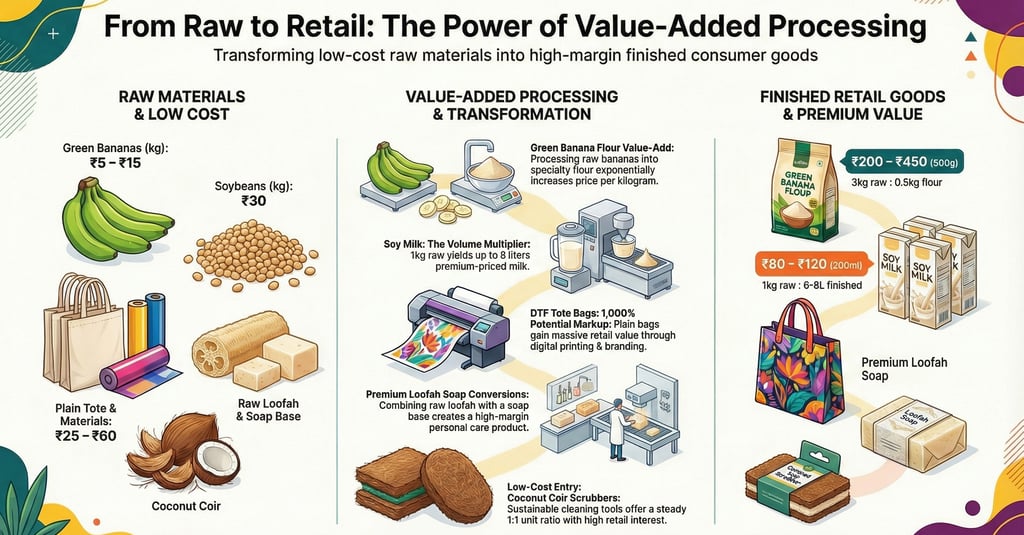
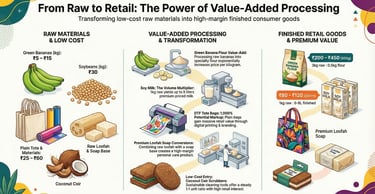
Table of Contents
Introduction: Why "Green" is the New "Gold" in India
Why Sustainable Branding is the Best Entry Point for New Entrepreneurs
Government Support
Consumer Shift
Low Competition
Top 5 Scalable Eco-Friendly Business Ideas for 2026
Idea 1: Coconut Coir Scrubbers — The Plastic-Free Kitchen
Idea 2: Designer Loofah Soaps — The Spa-at-Home Experience
Idea 3: Soy Milk and Vegan Dairy — The Fitness Revolution
Idea 4: Green Banana Superfood Flour — The Gluten-Free Market
Idea 5: DTF Printed Cotton Tote Bags — Eco-Fashion That Sells Itself
The Bizz Accelera 4-Step Launch Framework
Step 1: Sourcing and Raw Materials
Step 2: Low-Cost Machinery
Step 3: Branding and Packaging
Step 4: Digital Presence and First 100 Customers
Legal Checklist and Compliance for Indian Startups
Financial Reality Check: Investment vs. ROI
Frequently Asked Questions for Eco-Friendly Startups in India
Conclusion and Call to Action
Introduction:
If you are searching for eco-friendly business ideas India has never been more ready for, you are in the right place. Most people think starting a business means spending lakhs of rupees, renting a big factory, and hiring a team. But some of the fastest-growing brands in India right now are being built from small 10x10 rooms, using raw materials that most people throw in the trash. That is the power of the waste to wealth business model — turning agricultural by-products into premium plastic-free products business opportunities that solve real consumer problems.
That's not a sales pitch. That's the reality of India's eco-friendly business boom.
Starting an eco-friendly brand in India is currently one of the most profitable low-investment manufacturing opportunities available to regular people. The government has banned single-use plastics. The organic wellness market is growing at 15% every single year. And most importantly, there are very few local manufacturers meeting this massive demand.
The gap between what Indian consumers want and what's actually available? That's your opportunity.
What exactly is a sustainable home business? Simply put, it means creating high-value products — like coconut coir scrubbers, loofah soaps, soy milk, green banana flour, or printed cotton tote bags — using biodegradable raw materials and minimal machinery. These businesses typically require an initial investment of just ₹15,000 to ₹50,000 and can be operated from a small room in your home.
At Bizz Accelera, we call this the "Waste-to-Wealth" model. Cheap raw materials, premium branding, genuine environmental value, and serious profit margins. Whether you want to build a plastic-free products business or tap into the growing demand for natural alternatives, this guide gives you the exact roadmap.
This guide gives you the exact roadmap to launch five high-demand, earth-friendly businesses from scratch. No fluff. No theory. Just the real steps.
Why Sustainable Branding is the Best Entry Point for New Entrepreneurs
Before we get into the five ideas, let's talk about why now is the best possible time to start a sustainable home business in 2026. India's ban on single-use plastics came into force in phases, and the pressure on consumers and retailers to switch to eco-friendly alternatives is real. On top of that, becoming an MSME eco startup India recognises means you get access to government subsidies, easier bank loans, and priority procurement. You are not starting in a vacuum. The policy environment is actively pushing the market in your direction.
The government is on your side. India's ban on single-use plastics came into force in phases, and the pressure on consumers and retailers to switch to eco-friendly alternatives is real. On top of that, MSME (Micro, Small and Medium Enterprises) registration gives you access to government subsidies, easier bank loans, and priority procurement. You are not starting in a vacuum. The policy environment is actively pushing the market in your direction.
Indian Gen Z and Millennials have changed their buying habits. This is not just a Western trend anymore. The young urban Indian consumer in Bengaluru, Pune, Delhi, or Surat is reading ingredient labels, choosing refillable products, and willing to pay more for something that doesn't harm the planet. A 2023 Nielsen report found that over 73% of Indian millennials say they would definitely or probably change their consumption habits to reduce environmental impact. These are your customers. And they exist by the millions.
Competition is surprisingly low. Here's something most business advisors won't tell you. Demand for eco-friendly alternatives like natural scrubbers, chemical-free soaps, and plant-based milk is booming in Indian cities. But the number of small-scale, local, home-based producers meeting that demand is tiny. You are not competing with giant corporations. You are filling a real, urgent gap. That's a powerful place to start.
Top 5 Scalable Eco-Friendly Business Ideas for 2026
Now let's get into the ideas themselves. Each of these is a tested, real-world model that works at a small scale before you grow it bigger.
Idea 1: Coconut Coir Scrubbers — The Plastic-Free Kitchen
Every Indian kitchen uses a scrubber. Most of them are synthetic sponges made from plastic, loaded with chemicals, and they shed microplastic particles into your food and drain every single time you use them.
Starting a coconut coir scrubber business is one of the most straightforward entries into the plastic-free products business space. Made from the fibrous husk of coconuts, they are naturally antibacterial, biodegradable, and incredibly effective at scrubbing. And here's the business angle: coconut husks are agricultural waste. Farmers and coconut traders often give them away for almost nothing.
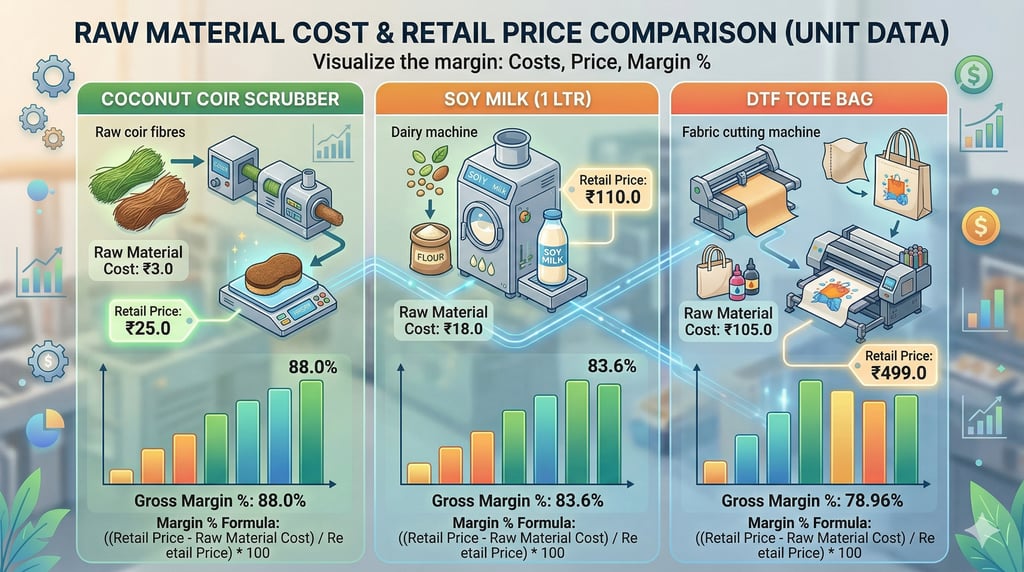
You buy the raw coir fibre, shape it using simple manual dies or a basic press, tie it with jute twine, and package it in recycled paper. Your cost per piece? Roughly ₹8 to ₹12. Your retail price? ₹45 to ₹80 per piece. Your margin? Enormous.
The market for this product spans kitchen stores, organic grocery stores, zero-waste Instagram shops, and Amazon. You can also sell packs of three or five to increase your average order value. A starter kit — a manual press, raw coir bales, and packaging — costs roughly ₹15,000 to ₹20,000.
Read the Full Guide: Deep Dive — Step-by-Step Coconut Scrubber Business Plan
Idea 2: Designer Loofah Soaps — The Spa-at-Home Experience
This is the highest-margin product on this list. And it looks absolutely stunning.
Loofah soap making at home requires only silicone moulds, a double boiler, basic ingredients, and a clean workspace. You do not need a factory. A natural loofah embedded inside a handmade soap bar creates a two-in-one product that feels luxurious, looks beautiful, and sells at a premium.
A loofah soap is exactly what it sounds like — a natural loofah (grown from the luffa gourd, widely cultivated in Maharashtra, Karnataka, and Andhra Pradesh) embedded inside a handmade soap bar. When the soap is used up, the loofah remains as a natural exfoliating scrubber. It's a two-in-one product that feels luxurious, looks beautiful, and sells at a premium.
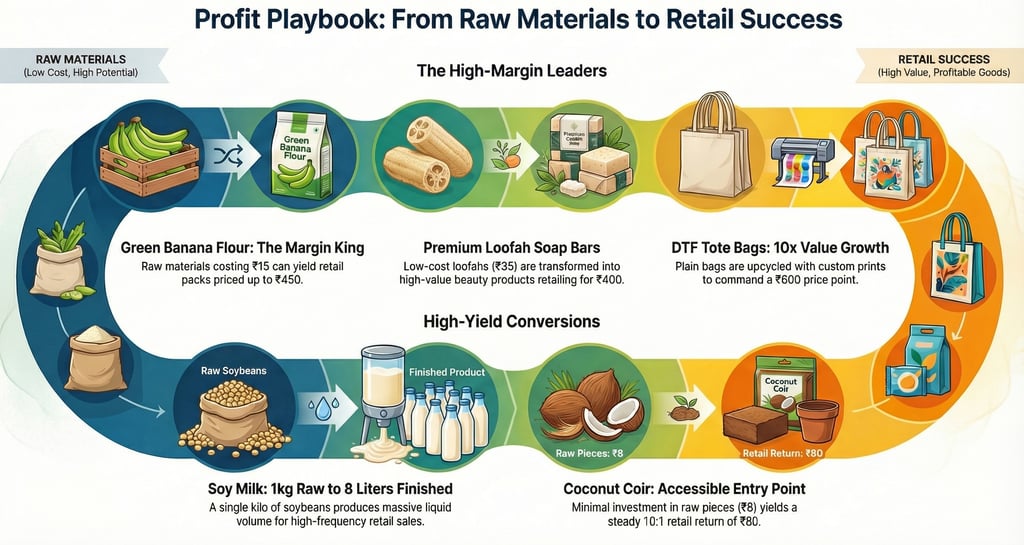
Raw loofah costs around ₹5 to ₹15 per piece wholesale. A basic cold-process soap base — coconut oil, shea butter, essential oils — costs maybe ₹30 to ₹50 worth of materials per bar. The finished product retails for ₹180 to ₹400 per bar. You don't need a factory. You need silicone moulds, a double boiler, basic ingredients, and a clean workspace.
The target customer is urban women aged 22 to 40 who follow skincare routines, buy natural beauty products, and love gifting. These soaps also photograph beautifully for Instagram, which is a huge advantage for digital marketing. Gift hampers of loofah soaps for Diwali, weddings, or corporate gifting can bring in bulk orders that change your monthly revenue entirely.
FSSAI license is not needed for soap. But you should register under Udyam and keep your ingredient list compliant with cosmetic standards.
Read the Full Guide: Deep Dive — How to Start a Loofah Soap Brand from Home
Idea 3: Soy Milk and Vegan Dairy — The Fitness Revolution
The soy milk business India is currently witnessing is driven by real demand from gyms, cafés, and health-conscious urban consumers. Walk into any urban café or health food store and you will see it. The supply of local, affordable, fresh soy milk is far behind the demand — and that gap is your opportunity.
Here's the math that makes this business so exciting. Soybeans cost approximately ₹30 per kilogram at wholesale. One kilogram of soybeans yields roughly 6 to 8 litres of soy milk. Premium packaged soy milk retails for ₹80 to ₹120 per 200ml. Do the maths on that. You're converting a ₹30 input into potentially ₹400 to ₹900 in retail value.
The equipment needed is a soy milk machine (automatic ones start at ₹8,000 to ₹15,000), a sealing machine for pouches, and a basic cold storage setup. You can start by supplying to local gyms, yoga studios, cafes, and health food stores. Build your customer base locally first, then expand to subscription deliveries via WhatsApp or your own website.
One important note: this is a food product. You will need an FSSAI Basic Registration to sell legally. This costs very little but is absolutely mandatory. Don't skip this step.
Read the Full Guide: Deep Dive — Launching a Soy Milk Brand in India.
Idea 4: Green Banana Superfood Flour — The Gluten-Free Market
Most Indians eat bananas every day but almost nobody is talking about what happens to the raw, unripe bananas that don't make it to market. Thousands of tonnes of raw bananas are discarded or sold for almost nothing every year in banana-producing states like Andhra Pradesh, Tamil Nadu, Kerala, and Maharashtra.
Raw banana flour — made by drying and grinding unripe green bananas — is a genuine superfood. It's rich in resistant starch, which supports gut health, blood sugar regulation, and weight management. It's completely gluten-free. And it's gaining rapid traction in the Indian fitness and health community.
Green banana flour manufacturing is one of the most underrated opportunities in India's food processing sector. The production process is straightforward — peel raw bananas, slice them thin, dry them, and grind into fine flour. Raw bananas cost roughly ₹5 to ₹15 per kg depending on season and region, while finished green banana flour retails for ₹200 to ₹450 per 500g pack.
This is a product you can genuinely brand as a superfood. Packaging matters enormously here. Kraft paper pouches, clean minimalist labels, and clear nutritional claims will make your product look premium and trustworthy.
FSSAI licence is required for this product since it is a food item.
Read the Full Guide: Deep Dive — Raw Banana Powder Manufacturing Guide
Idea 5: DTF Printed Cotton Tote Bags — Eco-Fashion That Sells Itself
Starting a DTF printed tote bag business is a little different from the others on this list. You are not manufacturing a product from scratch — you are value-adding to plain canvas bags using modern Direct to Film printing technology. No screen-printing setup needed. No huge investment. Just great design, smart branding, and a growing urban market that loves carrying bags that say something about their identity.
DTF stands for Direct to Film printing. It's a relatively new printing technique that allows you to print full-colour, highly detailed designs on fabric with no minimum order quantity and no colour limitations. You don't need a screen-printing setup or a huge investment. A basic DTF printing setup costs between ₹30,000 to ₹60,000, but many entrepreneurs start by outsourcing the printing and focusing on design and branding.
Plain cotton canvas tote bags cost ₹25 to ₹60 each at wholesale. With a printed design, your branding, and proper packaging, the same bag sells for ₹250 to ₹600 in urban markets, on Instagram, or on Etsy for international customers.
The eco angle is real. Cotton bags replace plastic bags. The fashion angle is real too. Young Indian consumers love carrying bags that say something about their identity — a funny quote, a Bollywood reference, a botanical illustration, a feminist slogan. That's your product. Design-forward, eco-friendly, and shareable on social media.
You can also offer custom corporate gifting (branded bags for companies replacing plastic bags at events) which is a high-volume, high-margin B2B channel.
Read the Full Guide: Deep Dive — Premium Printed Bag Business Strategy
The Bizz Accelera 4-Step Launch Framework
Knowing the idea is step one. Knowing how to actually launch it is where most people get stuck. Here is our four-step framework that works across all five businesses above.
Step 1: Sourcing and Raw Materials
The secret to your profit margin is your sourcing cost. For all five businesses above, the raw materials are either agricultural produce or agricultural by-products. That means your best suppliers are not on Amazon. They are at your local APMC mandi, through farmer cooperatives, or via wholesale agricultural markets in your state.
For coconut coir, contact coconut traders or oil mills in Tamil Nadu, Kerala, or Karnataka. For soybeans, check with local dal mills or agricultural wholesale markets. For raw bananas, partner directly with farmers or mandis in banana-producing regions. For loofah gourds, they grow easily in home gardens or are available at low cost from vegetable farmers.
Build personal relationships with your suppliers early. Consistent supply at a consistent price is what separates a real business from a side hustle.
Step 2: Low-Cost Machinery
Every business on this list can start manually. Yes, manual production is slower. But it lets you validate your market before spending on semi-automatic or automatic equipment.
For loofah soaps, your hands and a set of moulds are enough to start. For coconut scrubbers, a basic manual coir pressing die costs under ₹3,000. For banana flour, a wet grinder that you may already own works for small batches. Once your orders increase and you have consistent revenue coming in, reinvest in semi-automatic equipment to increase your output without increasing your effort proportionally.
Don't over-invest in machinery before you have customers. That is the number one mistake new manufacturers make.
Step 3: Branding and Packaging
This is where most small manufacturers leave money on the table. An eco-friendly product in a plastic pouch with a printed sticker is not going to command a premium price. Your packaging IS your brand.
Kraft paper pouches, recycled cardboard boxes, jute bags, seed paper tags — these are all affordable and they communicate your values instantly. A customer who picks up your banana flour in a clean kraft paper pack with a simple, well-designed label will pay ₹350 for it. The same flour in a generic plastic bag will get ₹150 at best.
Use free tools like Canva to design your labels. Order custom printed kraft pouches from wholesale packaging suppliers on IndiaMart. Keep it simple, clean, and honest. "Made in India. Zero Plastic. 100% Natural." That messaging is worth more than any advertisement you could buy.
Step 4: Digital Presence and First 100 Customers
You do not need a fancy website to get your first 100 customers. You need three things.
First, an Instagram account with 12 to 15 high-quality posts showing your product, your process, and your story. People love behind-the-scenes content from home-based makers. Show the raw materials. Show the making process. Show the finished product. Show the packaging. Tell them why you started. That is marketing that works.
Second, a WhatsApp Business account with a product catalogue. This is your storefront for word-of-mouth. Once your first 20 customers love the product, they will share your WhatsApp number. Set up quick replies, your working hours, and your delivery details.
Third, list your products on Amazon Handmade or Flipkart. These platforms already have millions of shoppers looking for natural, handmade products. Your listing with good photos and genuine reviews will find customers you would never have reached otherwise.
Your first 100 customers will come from your personal network, local wellness stores, and these three platforms. From there, the product quality does the marketing for you.
Legal Checklist and Compliance for Indian Startups
Let's talk about the legal side because ignoring it will cost you more later. Every MSME eco startup India registers gains access to subsidies, bank loan priority, and government scheme eligibility. Udyam Registration is the first and most important step — it is free, takes 15 minutes online, and there is genuinely no reason not to do it.
Udyam Registration is the first thing you should do. It's free, it takes 15 minutes online, and it classifies your business as an MSME. This gives you access to government subsidies, priority bank loans, and cheaper rates on various services. There is genuinely no reason not to do this.
FSSAI Registration is mandatory for any food or beverage product. This includes soy milk, banana flour, and any food item you plan to sell. A Basic FSSAI Registration (for businesses with annual turnover below ₹12 lakhs) costs ₹100 per year. A State Licence (for larger operations) costs more but is straightforward to apply for on the FoSCoS portal.
Trade License is required from your local municipal body to operate a business from your premises. This is usually issued by your Nagar Palika or Municipal Corporation and costs a nominal annual fee.
GST Registration is mandatory if your annual turnover crosses ₹40 lakhs for goods, or if you plan to sell on e-commerce marketplaces like Amazon or Flipkart, which typically require a GSTIN regardless of your turnover.
Cosmetics compliance is relevant specifically for loofah soaps. Products applied to the human body fall under the Drugs and Cosmetics Act. Ensure your ingredient list is compliant and that you are not making any medical claims on the packaging.
Explore Our Complete Business Compliance Guide for detailed, step-by-step checklists for each business type.
Financial Reality Check: Investment vs. ROI
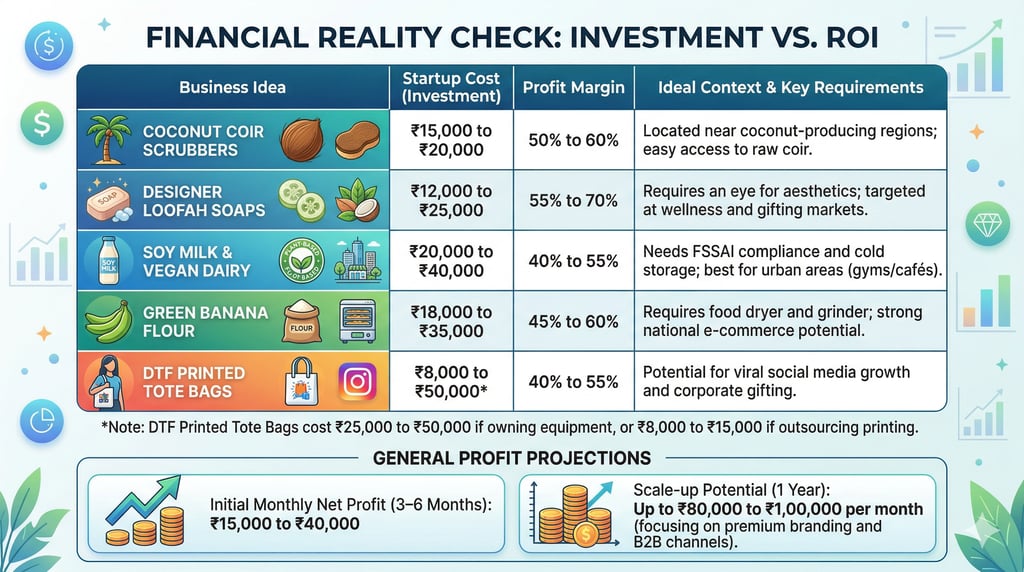
For anyone exploring low investment manufacturing India offers some of the most attractive margins in the eco-friendly sector. Here is the honest comparison you need before you decide which business to start.
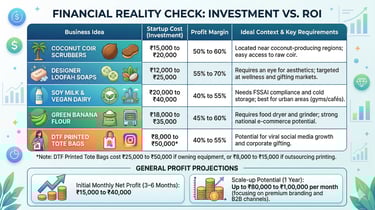
Coconut Coir Scrubbers: Startup cost ₹15,000 to ₹20,000. Profit margin 50% to 60%. Ideal for anyone near a coconut-producing region with easy access to raw coir.
Designer Loofah Soaps: Startup cost ₹12,000 to ₹25,000. Profit margin 55% to 70%. Highest margin on the list. Best for someone with an eye for aesthetics and a customer base in wellness or gifting.
Soy Milk and Vegan Dairy: Startup cost ₹20,000 to ₹40,000. Profit margin 40% to 55%. Requires FSSAI compliance and cold storage. Best suited for urban areas with gym and café clientele nearby.
Green Banana Flour: Startup cost ₹18,000 to ₹35,000. Profit margin 45% to 60%. Requires a food dryer and grinder. Strong e-commerce potential nationally.
DTF Printed Tote Bags: Startup cost ₹25,000 to ₹50,000 (if owning equipment) or ₹8,000 to ₹15,000 (if outsourcing printing). Profit margin 40% to 55%. High potential for viral social media traction and corporate gifting.
The bottom line is this. Even at the lower end of these profit margins, all five businesses can generate a monthly net profit of ₹15,000 to ₹40,000 within the first three to six months if you execute consistently. Some entrepreneurs who focus on premium branding and B2B channels hit ₹80,000 to ₹1,00,000 per month within the first year.
These are not lottery numbers. They are achievable with consistent effort.
Frequently Asked Questions for Eco-Friendly Startups in India
Can I start an eco-friendly manufacturing business from a small apartment?
Yes. Most eco-friendly ideas like DTF bag printing, loofah soap making, and coconut scrubber assembly are noise-free and require less than 100 square feet of space. They do not involve heavy industrial machinery, making them completely suitable for urban home-based setups. Many successful brands you see on Instagram today started in exactly this way.
Which government schemes provide loans for eco-friendly small businesses in India?
The PMEGP (Prime Minister's Employment Generation Programme) and MUDRA Loans under Pradhan Mantri Mudra Yojana are your best options. PMEGP offers a credit-linked subsidy of up to 35% for manufacturing units in rural areas and 25% in urban areas. MUDRA loans under the Kishore and Tarun categories can provide ₹50,000 to ₹10,00,000 without collateral. Completing your Udyam Registration is the essential first step to becoming eligible for both.
Is GST registration mandatory to sell eco-friendly products online in India?
If you plan to sell locally or through your own website, GST registration is mandatory only once your annual turnover exceeds ₹40 lakhs for goods. However, to sell on marketplaces like Amazon, Flipkart, or Etsy India, GST registration is almost always required regardless of your turnover. It is better to register early because it also makes your brand look more credible to buyers.
How do I ensure my green brand is legally compliant?
Compliance depends on what you are selling. Food items like soy milk and banana flour require an FSSAI Licence. Personal care products like loofah soap fall under the Drugs and Cosmetics Act and need compliant ingredient labelling. All businesses should have a Trade Licence and Udyam Registration. Check our Compliance Category for detailed product-specific checklists.
What is the average profit margin in the Waste-to-Wealth sector?
Among all organic home business ideas available today, the Waste-to-Wealth sector stands out for its exceptionally high profit margins ranging from 40% to 70%. The reason is simple: raw materials like coconut husks or raw bananas are extremely low-cost agricultural by-products, while eco-friendly branding allows premium retail pricing in urban markets.
Conclusion: Your Green Brand Starts Today
India's green economy is not a future trend. It is happening right now. If you have been looking for eco-friendly business ideas India's urban markets are ready to reward, you are already ahead of most people. From organic home business ideas like loofah soaps and banana flour to the full waste to wealth business model — the opportunity is real, the demand is growing, and the investment is within reach for almost anyone.
Here is the truth nobody tells you when you're searching for business ideas online. The perfect moment to start will never arrive, You do not need ₹5 lakhs and a factory. You need ₹15,000 to ₹50,000, a 10x10 room, and the willingness to start.
Pick one idea from this list. Read the deep-dive guide for that specific business. Follow the four-step framework. Get your Udyam registration done. Source your first batch of raw material. Make your first ten units. Get feedback. Improve. Repeat.
That is how every real brand starts. Including the ones you admire.
Need help in Business Registration and Compliance ? Contact Bizz Accelera Today.
Join the Bizz Accelera Newsletter for weekly low-investment business blueprints, sourcing guides, branding tips, and compliance updates delivered straight to your inbox. Because you don't have to figure this out alone.
Connect:
Get in touch with our expert team.
Follow us:
bizzaccelera@gmail.com
+91-9313528947
© 2025. All rights reserved.
Join Our News Letter
Disclaimer : The information provided on Bizz Accelera is intended for general informational and educational purposes only.