
Start a Printed Cotton Bag Business in India: ₹15 Bag to ₹350 with DTF Printing
Turn plain ₹15 cotton bags into ₹350 branded accessories using DTF printing. Step-by-step guide covering investment models, heat press settings, legalities, and marketing for beginners in India.
BUSINESS IDEAS
Bizz Accelera
5/5/202613 min read
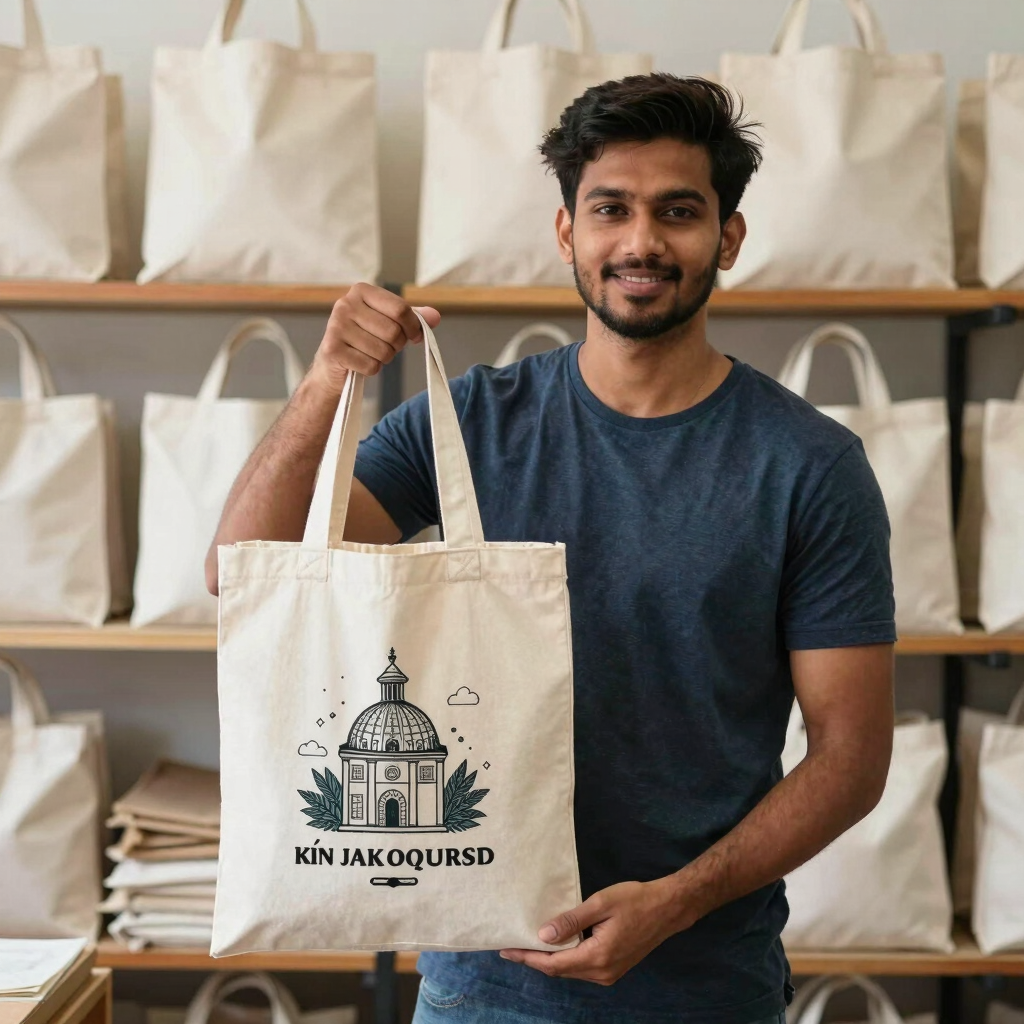
The Plastic Ban Changed Everything — Are You Ready to Cash In?
Walk into any mall in Bengaluru, scroll through Instagram in Mumbai, or step into a college campus in Pune — what do you see hanging off shoulders everywhere? Cotton tote bags. Not because people suddenly became environmentally conscious overnight (though that's part of it), but because the tote bag quietly became a fashion statement, a personality badge, a brand.
India's nationwide crackdown on single-use plastic didn't just hurt polybag manufacturers. It accidentally created one of the most exciting low-investment business opportunities of the decade. And most people are still sleeping on it.
Here's the math that should wake you up: a plain canvas bag costs ₹15 to ₹40 wholesale. Slap a well-designed, vibrant DTF print on it, pack it nicely, list it online — and you're selling it for ₹250 to ₹550. That's not a typo. That's a 60% to 80% profit margin on a product that weighs less than 100 grams and fits inside a shoebox.
This guide is for college students running low on pocket money, graphic designers sitting on unused skills, small gift-shop owners looking to expand margins, and anyone who's googled "low investment printing business ideas for beginners in India 2026" at 1am and fallen down a rabbit hole. This is the rabbit hole. Let's go deeper — but with a map this time.
Why Cotton Bags? Because the Market Is Screaming for Them
Before we talk machinery and margins, let's talk demand. Because a business with no buyers is just an expensive hobby.
India generates over 9.4 million tonnes of plastic waste annually. State after state has banned plastic bags under 75 microns. This isn't a trend — it's a structural shift in how India shops, carries, and gifts. Retailers, grocery stores, boutiques, and event organizers are all hunting for branded, reusable alternatives. Cotton bags are the answer everyone is reaching for.
But who's actually buying printed cotton bags right now?
Corporate gifting companies are placing bulk orders for logo-printed bags as client gifts and onboarding kits. Boutique fashion brands are using custom totes as packaging that doubles as marketing. Eco-conscious Gen Z consumers are buying aesthetic quote bags to carry to college. Event organizers are ordering custom bags for weddings, college fests, and brand activations. Local bakeries and artisan food brands are replacing plastic with printed cotton pouches.
The demand isn't a question. The question is: can you produce something worth buying?
The Problem Nobody Talks About: Why Most Beginners Get Stuck
Here's what usually happens. Someone gets excited about this business, they look up "how to print on cotton bags," and they land on screen printing. They call a local printer, hear the words "minimum order 200 pieces per design," calculate the upfront cost, and quietly close the tab.
Screen printing is a fantastic technology — for scale. But for someone starting out with ₹15,000 or even ₹50,000, it's the wrong tool. You can't test multiple designs without huge investment. You can't do 10 pieces of one design and 15 of another. Every new design needs a new screen, which means more money, more time, and more risk.
This is exactly where most beginners give up before they even start. And it's completely unnecessary, because there's a better technology sitting right at the intersection of quality, flexibility, and affordability.
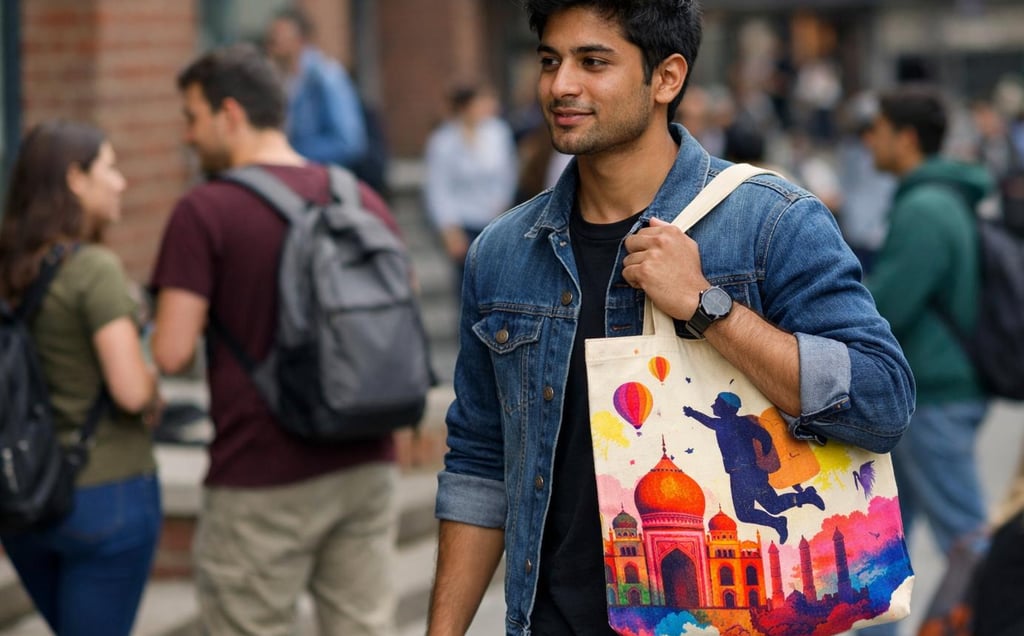
DTF Printing: The Game Changer You Didn't Know You Needed
DTF stands for Direct-to-Film. And if screen printing is a printing press, DTF is a smartphone — faster to set up, easier to customize, and far more accessible for small batches.
Here's the simple version of how it works: your design gets printed onto a special PET film using a DTF printer and water-based inks. Then a hot-melt adhesive powder is applied and cured. This creates a transfer film. You then use a heat press to bond this film directly onto the fabric. Peel it off, and your design is permanently fused to the bag.
So is DTF printing more profitable than screen printing for small businesses? The honest answer is: for batch sizes under 200 pieces, absolutely yes. Here's why.
With screen printing, your break-even only makes sense at high volumes. The setup cost per design is fixed and high. With DTF, you're paying per print area, and you can print a single piece as profitably as you print fifty. Want to test 5 different designs with 10 bags each? DTF makes that possible without financial suicide.
The quality argument is equally strong. DTF prints are vibrant, full-color, and photo-realistic. They're stretchable, so they don't crack when the bag flexes. They're wash-resistant when applied correctly — surviving 30 to 50 machine washes easily. And they work on cotton, canvas, jute, and blended fabrics without any pretreatment.
Sourcing the Right Canvas: How to Find Quality Wholesale Cotton Bags in India
The print is only as good as the surface it sits on. This is a mistake beginners make constantly — they spend hours perfecting a design and then apply it to a flimsy, low-GSM bag that looks cheap the moment a customer holds it.
When looking for high quality wholesale canvas bag manufacturers in India, here's what to evaluate before placing any order.
GSM (Grams per Square Metre) is your quality indicator. For a premium tote bag that customers will actually reuse, aim for 180 GSM to 300 GSM. Anything below 150 GSM feels like tissue paper. Anything above 300 GSM starts getting stiff and uncomfortable. The sweet spot for a branded gift-worthy bag is 200 to 250 GSM.
Stitching quality matters enormously. Double-stitched handles are non-negotiable. A bag that rips at the handle after two uses is a customer service disaster and a brand reputation killer. Always order samples and physically stress-test the handles before committing to bulk orders.
For preventing shrinkage and color bleeding, ask your supplier whether the fabric is pre-washed or pre-shrunk. Raw, untreated cotton can shrink up to 5% after the first wash, which distorts your print. Also, darker raw fabrics can bleed color during curing — always test before bulk production.
Good wholesale sources in India include markets in Kolkata's Burrabazar, Delhi's Gandhi Nagar, Surat's fabric wholesale zones, and increasingly, platforms like IndiaMART and TradeIndia for verified bulk suppliers. Always ask for GSM certificates and request samples before committing.
Step-by-Step: How to Actually Make a Premium Printed Cotton Bag
Let's get practical. Here is the full production process, broken down so even a complete beginner can follow it.
Step 1: Design and Sourcing Your Artwork
Your design is your product's soul. A well-designed bag sells itself; a generic one sits in inventory. If you're a graphic designer, this is your moment to shine. Use Adobe Illustrator or CorelDRAW for vector designs, or Canva Pro for quick concepts. Resolution should be minimum 300 DPI at actual print size.
Not a designer? You don't need to be. Platforms like Creative Market, Envato Elements, and Freepik offer commercial-use design assets. You can also hire freelance designers on Fiverr India for ₹500 to ₹2,000 per design. Build a library of 10 to 15 strong designs before launch — covering aesthetic quotes, local culture references, minimal art, and corporate-ready templates.
Step 2: Printing the DTF Film
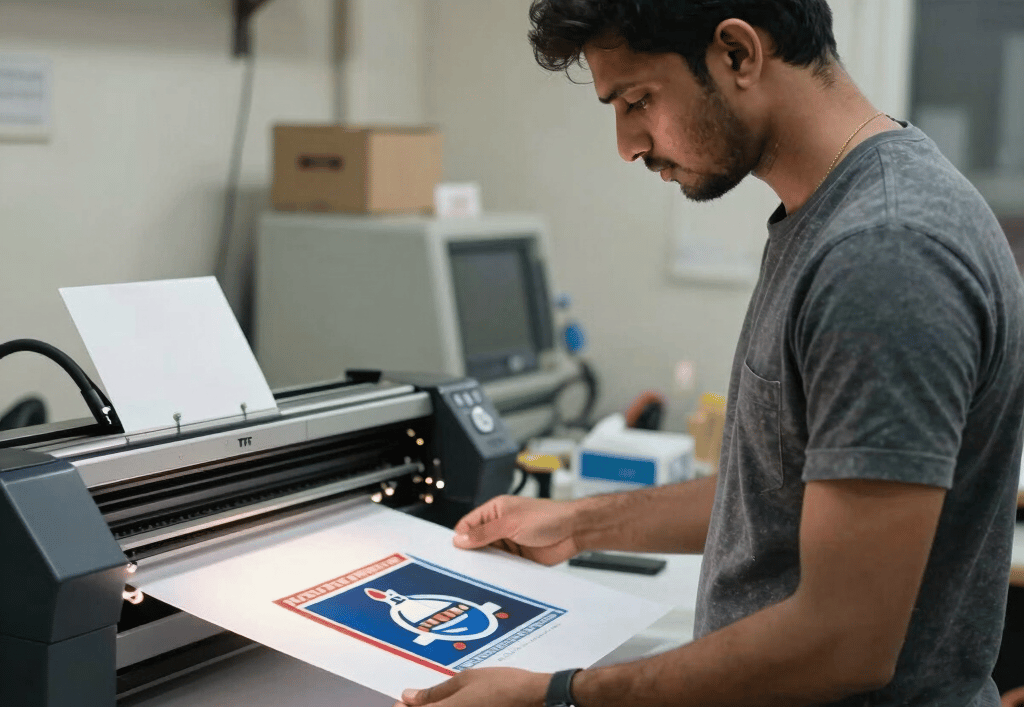
Send your high-resolution design file to a DTF printing service (if outsourcing) or print in-house using your DTF printer. The design is printed in mirror/reverse onto PET film using CMYK plus white ink (the white layer is what makes colors pop on fabric). Immediately after printing, hot-melt adhesive powder is applied evenly over the wet ink and then cured in an oven or curing station at around 120°C to 130°C until the powder melts into a smooth adhesive layer.
Step 3: Heat Press Application
This is where the magic happens — and where beginners often make costly mistakes by getting the settings wrong.
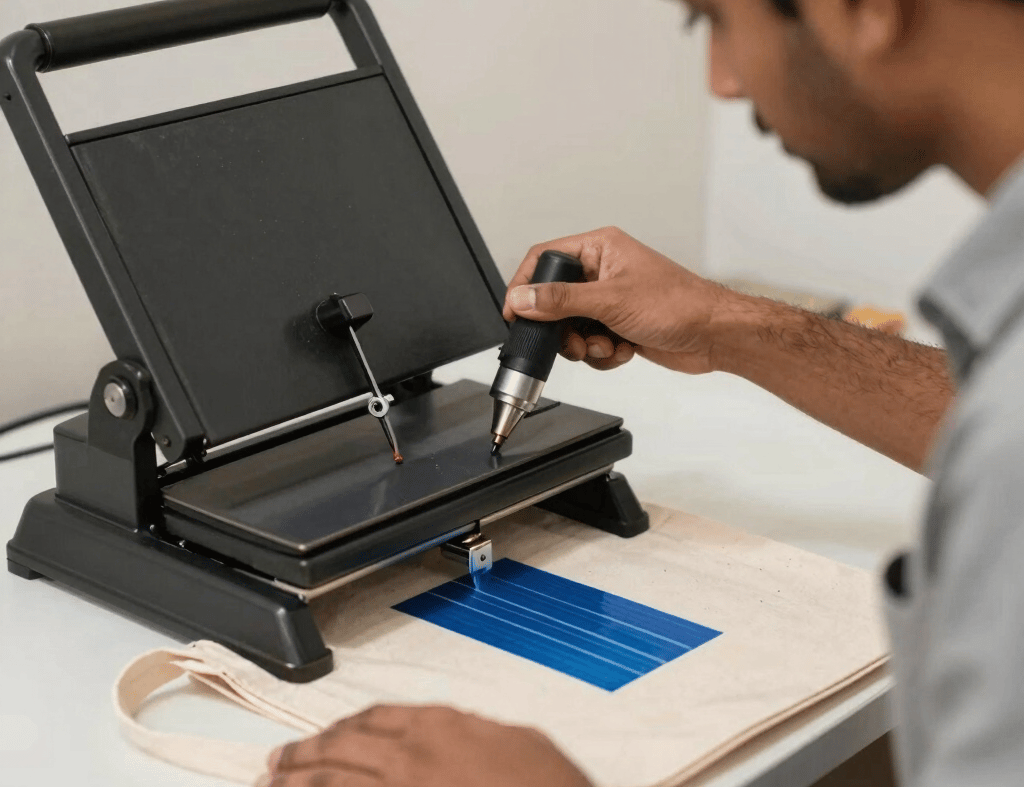
The best heat press settings for DTF printing on cotton bags in India are: temperature between 160°C and 170°C, pressing time of 15 seconds, and medium-to-firm pressure. These settings ensure the adhesive fully bonds with the cotton fibers without scorching the fabric. Below 160°C and your print won't adhere properly. Above 175°C and you risk burning the bag or making the colors dull.
Place your DTF film face-down onto the bag. Cover with a silicone sheet or parchment paper to protect the platen. Press for exactly 15 seconds at 165°C. Lift the press firmly.
Step 4: Peeling and Finishing
Here's where you choose between hot peel and cold peel, depending on your DTF film type. Hot peel films can be peeled immediately after pressing — you'll see a slightly glossy finish. Cold peel films require waiting 15 to 30 seconds before peeling — this gives a matte, more fabric-integrated look that many premium brands prefer.
Peel slowly and at a low angle. If any part of the design lifts with the film, lay it back down and give it another 5-second press. After peeling, give the design one more 5-second press with parchment paper on top — this is called the finishing press, and it significantly improves wash durability and surface smoothness.
Preventing DTF Print Cracking and Peeling: The Troubleshooting Guide
Nothing is more disheartening than a beautiful design cracking after the first wash. But this is almost always a process error, not a technology failure. Here are the most common causes and fixes.
Cracking usually happens when the heat press temperature was too low, the press time was insufficient, or the adhesive powder was applied unevenly. Fix: always calibrate your heat press with a thermometer before production runs. Press thermometers are available for under ₹1,000 online.
Peeling at edges happens when pressure is uneven — often because the bag's handles or seams are creating an uneven surface. Fix: use a silicone pad or foam pad on your platen to ensure even pressure across the entire print area.
Color fading after washing is usually a sign of poor-quality DTF ink or film, or insufficient curing of the powder. Fix: buy DTF supplies from reputable suppliers (JPSS, Bharath DTF, and similar India-based distributors have established quality reputations). Always cure the powder until it's fully melted — it should look smooth and glassy, not powdery.
Financial Outlook: The Numbers That Make This Business Real
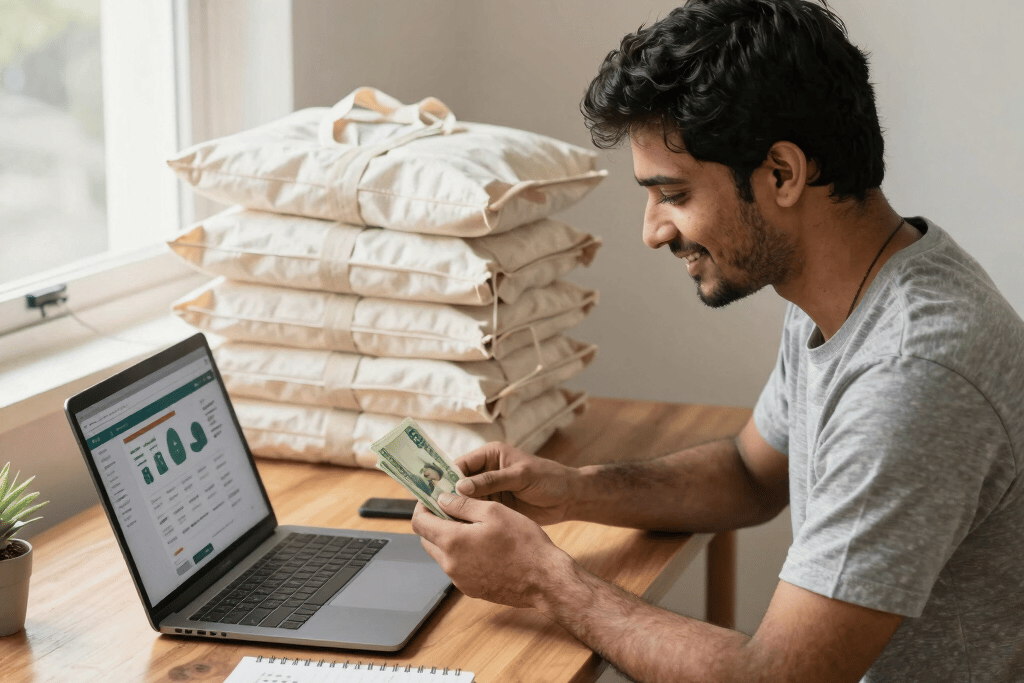
Let's break down the unit economics so you know exactly what you're working with.
A plain canvas bag (200 GSM) costs ₹15 to ₹40 depending on size and quantity ordered. A DTF print for an A4-sized design (roughly 20cm x 28cm) costs ₹20 to ₹40 if outsourced, or ₹8 to ₹15 if printed in-house. Add ₹5 for packaging (poly bag, tissue, sticker). Your total cost per unit: ₹40 to ₹85.
Your selling price: ₹250 to ₹550 depending on design, channel, and positioning. Net profit per bag: ₹150 to ₹400. Profit margin: 60% to 80%.
Sell 5 bags a day. That's ₹750 to ₹2,000 daily. ₹22,000 to ₹60,000 monthly. From your room. With a heat press and a good design.
Model 1 — The Micro-Scale Startup (₹10,000 to ₹25,000)
Ghar baithe tote bag printing business shuru karne ki jankari — this model is exactly that. You outsource DTF film printing to a local or online DTF service (there are many across Jaipur, Surat, Delhi, and other cities offering per-piece film printing with 24-48 hour turnaround). Your only hardware investment is a heat press machine, which costs ₹8,000 to ₹18,000 for a reliable 38x38cm unit.
This model is ideal for testing demand without committing to expensive equipment. You focus entirely on design, marketing, and sales. Once your monthly orders cross 200 to 300 pieces, you graduate to Model 2.
Model 2 — Full In-House Unit (₹2.5 Lakhs to ₹5 Lakhs)
Here you own the entire process. An automatic DTF printer price in India for small scale startups typically ranges from ₹1.5 lakhs to ₹3.5 lakhs depending on print width and brand. Add a powder shaker-curing machine (₹40,000 to ₹80,000), a commercial heat press (₹20,000 to ₹40,000), and your initial raw material inventory. This setup gives you full cost control, faster turnaround, and the ability to offer custom printing services to other local businesses — creating an additional revenue stream.
Legalities: From Side Hustle to Legitimate Business
You can start producing and selling informally. But the moment you want to sell on Amazon, Flipkart, or Myntra — or bill a corporate client — you need a formal business identity.
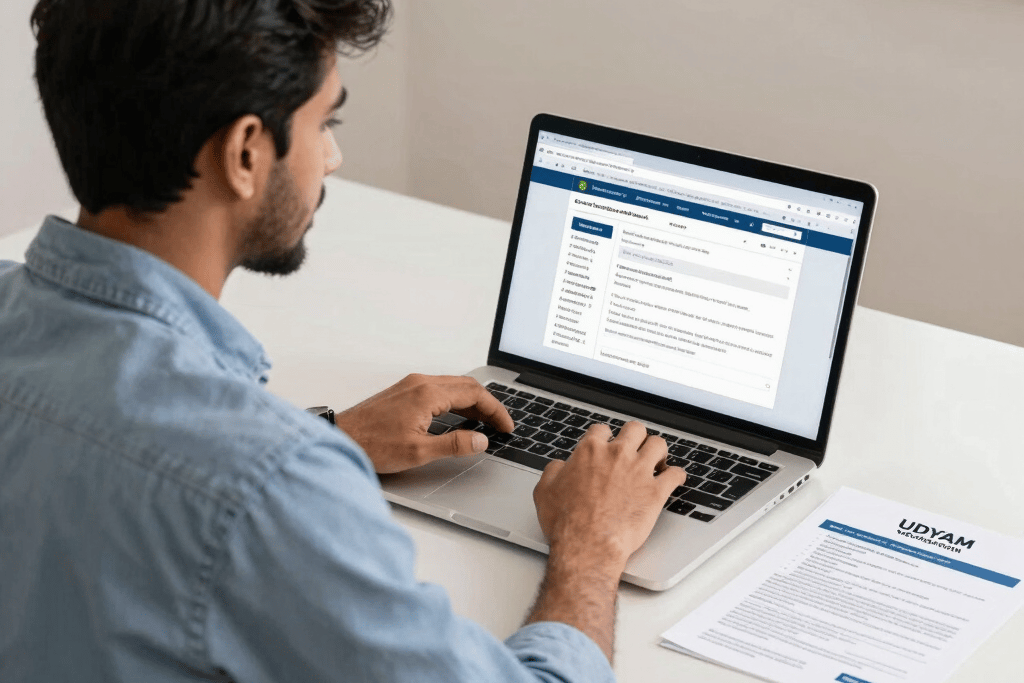
Udyam Registration is your first step. It's free, 100% online, and takes under 30 minutes. It classifies you as an MSME, which opens doors to government subsidies, collateral-free loans, and priority credit. Go to udyamregistration.gov.in with your Aadhaar and PAN.
GST Registration is non-negotiable for e-commerce. Every seller on Amazon or Flipkart must have a GSTIN. It also lets you issue proper invoices for corporate orders (companies need GST invoices to claim input tax credit). GST registration is done through the GST portal and typically takes 3 to 7 working days.
A Trade License from your local municipal body is required for operating a production unit from a commercial space. If you're working from home in a residential area, check your state's home-based business rules.
The paperwork can feel overwhelming. Many entrepreneurs lose weeks to this step. Using a professional service that handles registration end-to-end digitally can save you that time and let you focus on what actually makes you money: designing and selling.

Marketing & Sales: How to Sell Custom Printed Cotton Bags on Instagram and Amazon
A beautiful bag with no marketing is invisible. Here's how to make your product impossible to ignore.
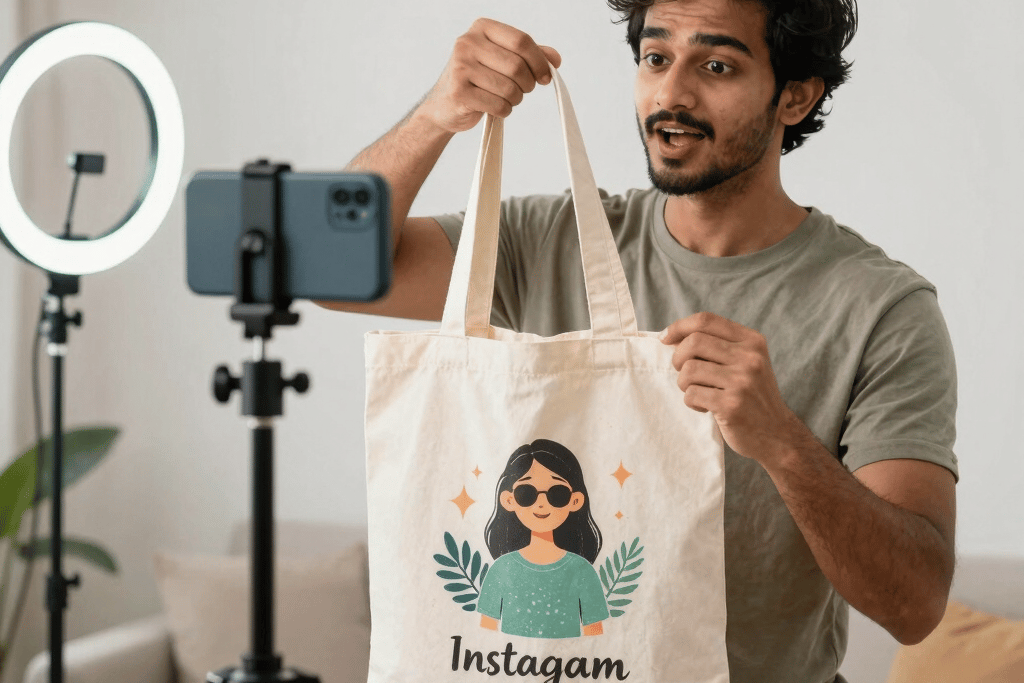
On Instagram, your content strategy should be visual-first and niche-specific. Don't try to appeal to everyone. Pick a lane — aesthetic quotes for college girls, local pop culture for urban youth, minimalist designs for corporate professionals — and own that lane. Post reels showing the heat press process, before-and-after transformation shots, and customer unboxing videos. This content gets shared organically because it's genuinely interesting to watch.
Content ideas in Hinglish that work particularly well: "₹15 ka plain bag, DTF machine se ₹350 ka premium product — dekho kaise" or "cotton bag par print karke paise kamane ka naya tarika 2026" — these are relatable, curiosity-triggering hooks that stop the scroll.
On Amazon, your listing success depends on keywords in your title and bullet points, high-quality product photography (white background plus lifestyle shots), and getting early reviews. Start by offering a slight discount to your first 20 buyers in exchange for honest reviews. A 4.3+ rating product with good keywords will find its own organic traffic.
Saste cotton bags ko premium brand kaise banaye DTF machine se — this isn't just a keyword phrase. It's your actual business philosophy. The bag is cheap. The design, the story, the branding — that's what makes it premium. Charge accordingly.
Corporate gifting is an underexplored goldmine. A single corporate client ordering 500 branded bags for their annual event can generate ₹75,000 to ₹1,50,000 in revenue from one order. Reach out to HR departments, event management companies, and startup offices in your city with a sample kit and a pricing sheet.
Frequently Asked Questions
Can I start this business without buying a DTF printer?
Absolutely. In Model 1, you outsource DTF film printing to a third-party service and only use a heat press. This dramatically reduces startup costs and is the recommended approach for beginners.
What is the minimum investment needed to start a tote bag printing business in India?
You can realistically start for ₹10,000 to ₹20,000. This covers a basic heat press, an initial batch of plain bags, outsourced DTF films, and basic packaging supplies.
How many bags do I need to sell to recover my initial investment?
With a ₹20,000 startup investment and a profit of ₹150 per bag, you need to sell approximately 133 bags to break even. At even modest sales of 5 bags a day, that's less than a month.
Is GST registration mandatory to sell on Amazon India?
Yes. Amazon, Flipkart, and all major Indian e-commerce platforms require a valid GSTIN for seller registration. This is non-negotiable.
How durable are DTF prints on cotton bags?
When applied correctly at the right temperature and pressure, DTF prints can withstand 30 to 50 machine washes without significant fading or cracking. Wash durability improves further with a finishing press after peeling.
Can I sell these bags in bulk to corporate clients without a registered business?
You can accept informal orders, but corporate clients almost always require GST invoices for accounting and tax purposes. A registered business with GSTIN is strongly recommended for corporate sales.
What designs sell best on Instagram and Amazon?
Niche-specific designs outperform generic ones. Local language quotes, pop culture references, minimalist line art, and nature-inspired designs consistently perform well. Avoid generic motivational quotes — that space is oversaturated.

Conclusion: Your ₹15 Bag, Your ₹350 Future
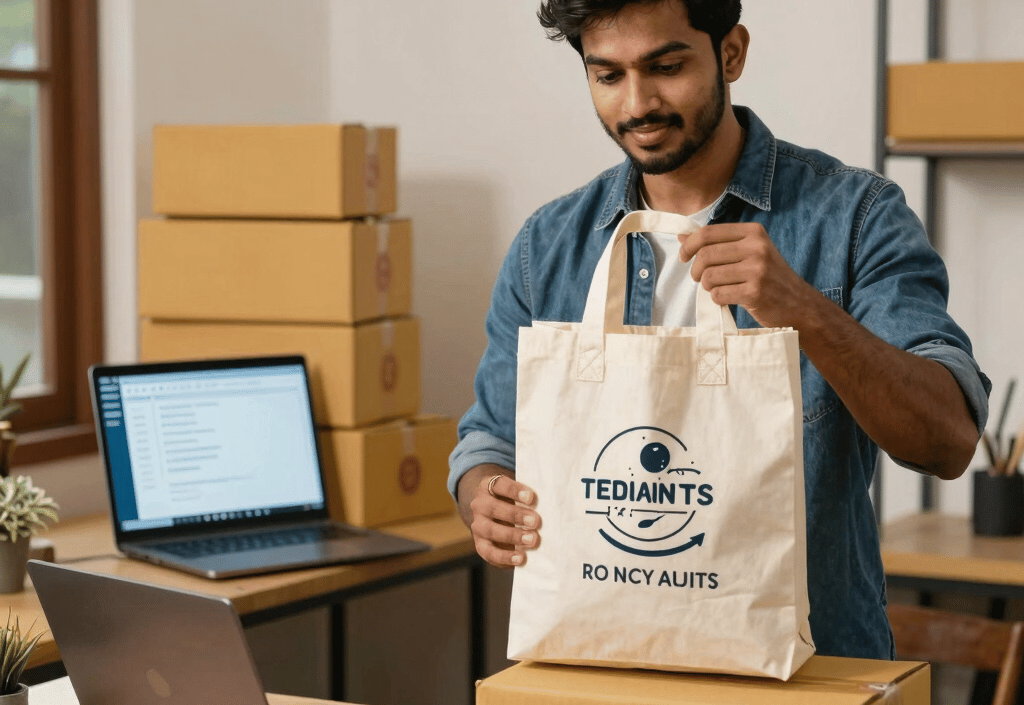
Let's recap what you now know. India's eco-shift created a massive demand gap for printed cotton bags. DTF technology eliminated the high-volume minimum order problem that was blocking small entrepreneurs. Your profit margin per bag is 60% to 80%. You can start from home with under ₹25,000. And you can scale to a full in-house operation at your own pace.
The barriers to entry are genuinely low. The margins are genuinely strong. The demand is genuinely growing. What's missing is you — actually starting.
Here's your action plan for this week: order a sample batch of 20 to 30 canvas bags (200 GSM, double-stitched handles) from a wholesale supplier. Finalize 3 to 5 designs — either design them yourself, buy commercial assets, or hire a freelancer. Get a quote from a local DTF printing service for your films. Get your hands on a heat press — even a budget one works to start. Register on Udyam. Begin your GST registration. Set up an Instagram business account and list your first products.
Every day you wait, someone else in your city is pressing print.
Not the right fit for you? Explore our high-impact, low-investment alternatives.
Need help with Business registration and Compliance? contact Us Today.
Connect:
Get in touch with our expert team.
Follow us:
bizzaccelera@gmail.com
+91-9313528947
© 2025. All rights reserved.
Join Our News Letter
Disclaimer : The information provided on Bizz Accelera is intended for general informational and educational purposes only.